In the previous article I showed that instead of thinking of foods as members of different Food Groups, we should we thinking of foods as sources of protein, fat, carbohydrates, and other nutrients.
What I will demonstrate in this article is that plants provide the proper protein-fat-carbohydrate ratio, sufficient energy, and the proper nutrients for optimal health.
This is not in dispute.
How much protein, fat, and carbohydrates should you eat?
First thing to do is to change the way you think about how much protein, fat, and carbohydrates you eat. Most guidelines tell you how much of each you should be consuming as a specific number of grams. This is completely confusing and unnecessary.
There is an easier way to think about these nutrients. We know that every food item we eat contains these nutrients in different proportions: protein, fat, and carbohydrates. The easier way of thinking about protein, fat, and carbohydrates is to consider how much are we eating as a percent of the total calories we eat every day. I will be transforming the following discussion into these parameters and you will see just how easy it is.
I will make an assumption that the USDA (United States Department of Agriculture) and the WFP (World Food Program) are fairly accurate in their healthy eating recommendations. After manipulating their data a bit, here’s a simplified chart outlining how much protein, fat, and carbohydrate the USDA and the WFP recommend people should be eating as a percentage of the total calories consumed on a daily basis.
| Protein | Fat | Carbohydrate | |
| USDA | 20% | 27% | 52% |
| WFP | 10% | 17% | 73% |
A picture is worth a thousand words:
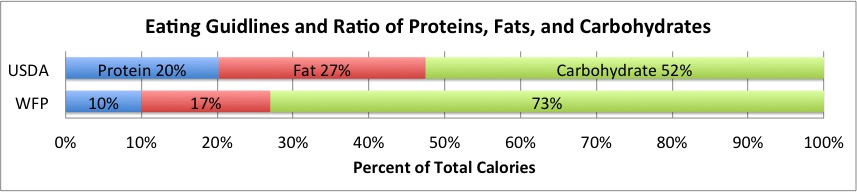
Just what does this mean?
- Daily consumption of protein should be between 10-20% of total calories
- Daily consumption of fat should be between 17-27% of total calories
- Daily consumption of carbohydrates should be between 52-73% of total calories
Now unless you are subscribing to one of the misguided paleo or no/low-carbohydrate diet plans, these are the ratios you should be consuming these basic nutrients on a daily basis.
How is it possible that eating just plants can provide these nutrients? Let’s see…
Another picture, this one worth four-thousand words:
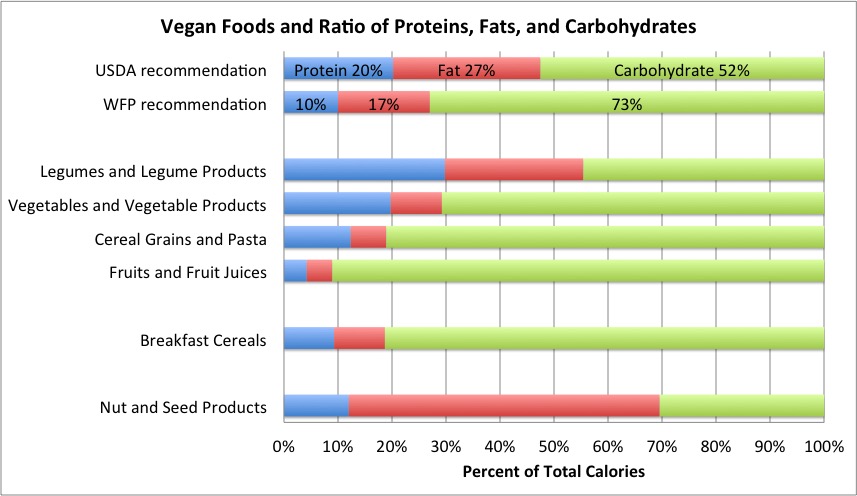
Four-thousand words summarized: eating vegan foods provides sufficient protein, fat, and carbohydrate for a healthy diet. A balanced diet containing foods from these vegan categories will provide all of these necessary nutrients.
- All vegan foods contain protein (most provide over 10% protein by total calories).
- All vegan foods contain fat.
- All vegan foods contain carbohydrates.
Now if you are going to be silly about this, you could create a couple scenarios in which a person does not get enough of these nutrients. But let’s be realistic: no one is going to seriously suggest that eating nothing but fruits (protein deficiency) or eating nothing but nuts (fat overload) is a reasonable argument against the proposition that eating vegan foods provides all the protein, fat, and carbohydrate needed for a healthy diet.
Before continuing, let me explain where I collected this data. I spent several afternoons painstakingly downloading, sorting, and combining data from the USDA Food Composition Database. The database contains nutrition information on literally thousands upon thousands of foods; everything you might possibly eat and things you won’t ever consider eating. There’s even information on the nutrition composition of breast milk! Anyway, for the food categories I included in the chart above, I selected and combined the data for the “top 20” or so foods in each category that a normal person (i.e. myself) likely eat on a regular basis. There is no skewing of data or selective selection of the data.
So I’m hoping that you see how eating a balanced diet of vegan foods provides sufficient quantities of protein, fat, and carbohydrates.
Thought experiment: vegan foods provide sufficient energy
Without going into increasing complexity concerning the number of calories everyone needs on a daily basis and the calorie-density of all foods, try this thought experiment.
- Vegan foods provide the proper protein-fat-carbohydrate ratio…
- Therefore, if you need additional calories, go ahead and eat some more plants!
Thought experiment: vegan foods provide all the nutrients
Another thought experiment that will be expanded in subsequent pages: vegan foods can provide all the nutrients needed on a daily basis.
- Neither the USDA nor the WFP recommend taking dietary supplements…
- Therefore, the guidelines (that include eating animals) from both the USDA and WFP must contain sufficient nutrients for proper health and nutrition…
- Eating animals provides little nutrition beyond protein and fat…
- Therefore, removing animal products from these diets, and replacing those calories with calories from additional plant foods will provide excess nutrients!
I hope you are starting to understand how and why following a vegan diet can be nutritionally complete.
I will get into more detail on why animals and animal-products should NOT be eaten in subsequent articles.
 Astute Vegan